


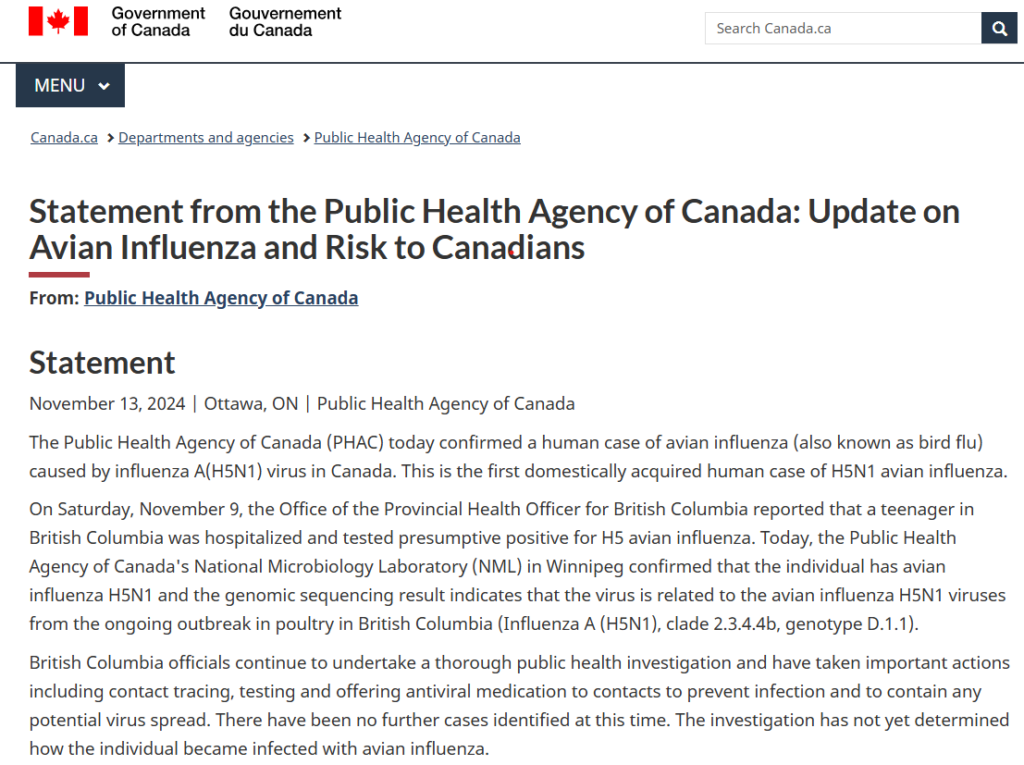
In Canada, there has been the first reported instance of a locally acquired H5N1 avian flu case in a human: a teenager that is currently hospitalized in critical condition.
On Saturday, 11/9/2024, the province of British Columbia in Canada reported that a teenager tested “presumptive positive” for H5 avian flu. The teen is from the Fraser region and was reported to be “receiving care” at BC Children’s Hospital. The BC government stated that an investigation was underway to determine how this person got infected with an H5 avian flu virus.

This announcement sparked a flurry of attention, as any human H5N1 case would, but for a young individual to be hospitalized the case must be severe.
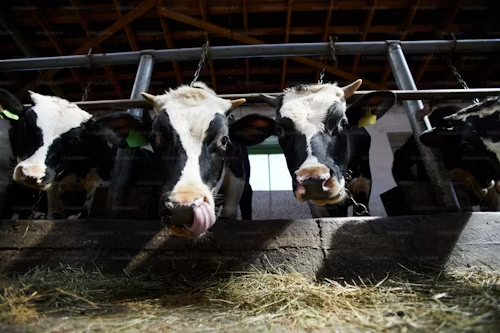
Unlike the U.S., Canada has not reported H5N1 infections in dairy cattle. There have, however, been outbreaks on poultry farms and detections in wild birds and mammals. As the press release noted, there has been “increased detections of H5N1 avian influenza in poultry farms and wild birds” starting in October, with “at least 22 infected poultry premises” and “numerous wild birds” positive for H5N1. So avian influenza is definitely in the same general area of this new human case, but the route of this person’s exposure and infection is not clear.
On Tuesday, 11/12/2024, Dr. Bonnie Henry, the provincial health officer of British Columbia, gave an update on this H5 human case. The update was made through a video conference.
Clinical Presentation and Case Details:
The patient was described as a healthy teenager with no underlying conditions. Their initial symptoms began on Saturday, 11/2/2024, with conjunctivitis, fever, and cough. They went to the emergency room, after which they were sent home.
On Friday, 11/8/2024, the patient returned to the hospital “when the symptoms continued to worsen.” The teen was admitted to the hospital late Friday evening. It was then that H5 testing was done, which came back positive. The virus was confirmed as H5N1 on Wednesday, 11/14/2024, by the Public Health Agency of Canada.
Over the weekend the patient’s “condition varied.” They are currently in critical condition, receiving “as much possible treatment as available,” including IV antivirals. During the Q&A session, Dr. Henry elaborated on this and stated that “things have progressed” and the patient is “experiencing acute respiratory distress syndrome.”
Of note, much earlier in the video conference, Dr. Henry briefly referenced studies suggesting that prior exposure to H1N1 viruses may play a role in the mild nature of the recent human H5N1 cases. She said that this “could be one of the reasons why younger people may get more severe illness and get that lower respiratory tract disease compared to adults.”
I thought that remark was interesting. At that point, she had not yet used words like “severe respiratory” illness or “lower respiratory” illness, so I wondered why she would go into that tangent. Unless there was some reason. It is very serious if the patient is experiencing acute respiratory distress syndrome (ARDS). This is unfortunate to hear, and my prayers are with this teen’s family.
Epidemiological Investigation & Exposure Route:
According to Dr. Henry, “right now we have no specific source identified”. So the health authorities currently do not know where or how this teenager was exposed to H5N1 or how they got infected with the virus, but there are “a number of leads” being pursued.
The investigation found “no link to any of the infected poultry premises” in the area. The patient does not live on a farm or work on a farm, and does not live with anyone associated with farms, poultry or otherwise.
Dr. Henry mentioned that this teenager did have exposure “to a variety of animals” like dogs, cats, and reptiles, but not birds. They apparently did have contact with a sick dog, and so far “all tests” of the animal have been negative. They are exploring all possible animal sources for exposure to the H5 virus, but stated “right now we have no specific source identified.”
According to the Public Health Agency of Canada, genomic sequencing of the virus from this patient shows it is “related to the avian influenza H5N1 viruses from the ongoing outbreak in poultry in British Columbia,” which are H5N1 clade 2.3.4.4b viruses of the D.1.1 genotype. This is a different genotype than the dairy cattle viruses in the U.S. (B3.13) and is slightly different from the H5N1 viruses recently isolated from poultry and pigs in Oregon (D.1.2 genotype).
The public health authorities again reiterate that they have not yet determined how this individual contracted H5N1. Dr. Henry noted that they are investigating all possible “environmental” sources, but also stated that “[t]here is a very real possibility that we may not ever determine the source.”
Contact Tracing:
The public health authorities in British Colombia and the local authorities in the Fraser region have reached out to all persons in contact with the patient, and so far “have not identified any additional cases.” Dr. Henry noted that thus far, about three dozen people have been tested for the virus.
Several times Dr. Henry mentioned the fact that this teen “was not in school during their infectious period,” which she explained is typically 2 days before symptom onset through as long as 10 days. During the Q&A, a reporter asked what I was wondering, which was why wasn’t this teen in school that whole time. In reply, she vaguely stated that there are a “variety of reasons” then focused more on the contact tracing efforts. Again, contact tracing has uncovered no other cases and the person’s contacts have been offered oseltamivir.
Condition, Treatment, and Prior Studies:
The patient remains in critical condition, with what is clearly severe respiratory disease. Dr. Henry noted that over the past weekend, they have received multiple drug therapies trying to address the “severe respiratory condition” but did not go into the specifics of that treatment regimen.
The description of the patient’s condition, especially the mention of “acute respiratory distress syndrome,” reminded me of some prior human cases of avian influenza. What they show us is that ARDS requires a substantial amount of intense hospital care for a long period of time.
In a 2011 H5N1 study involving ferrets, the authors noted that “[m]ost patients infected with highly pathogenic avian influenza A/H5N1 virus develop severe pneumonia resulting in acute respiratory distress syndrome, with extrarespiratory disease as an uncommon complication.”
-
- The condition is also common in human cases of H7N9 avian influenza.
-
- In a 2015 study of a fatal H5N6 human case in China, the patient’s initial symptoms of sore throat and coughing, which “rapidly progressed to severe pneumonia, multiple organ dysfunctions and acute respiratory distress syndrome.”
-
- In April 2021, a 41 year old man in China with underlying conditions was hospitalized with H10N3 avian influenza. He initially had fever and fatigue, which progressed into severe pneumonia and acute respiratory distress syndrome. The patient was hospitalized for over a month during which he received “extensive supportive care, including treatment with oseltamivir and extracorporeal membrane oxygenation.” The initial WHO report noted “no clear history of exposure to poultry” for the patient, but in a subsequent study it was noted that the patient had visited a live poultry market a week before symptom onset.
-
- In June 2021 a boy, under age 18, from India tested positive for H5N1. The report from the WHO noted that the boy initially had “fever, cough, upper respiratory symptoms and breathing difficulty” after which his “condition progressed to acute respiratory distress syndrome” requiring mechanical ventilation. He died a month later. The epidemiological investigation noted that there were no reports of sick or dead poultry in the boy’s village and none of his family members were ill. The source of infection was not known.
-
- In April 2022, a four year old boy in China was hospitalized with H3N8 avian influenza. He initially had fever, lethargy, and cough but was admitted to the hospital when his symptoms worsened. The patient exhibited signs of organ failure and sepsis after a systemic inflammatory response and severe respiratory disease. He had “developed severe respiratory distress syndrome” but without any apparent bacterial cause. He received extensive antiviral and antibiotic treatment and was put on a ventilator. After 90 days in the hospital, he was discharged. The investigation found that a dog and cat from the same household tested positive for H3N8 and the virus was found in samples around the home. No other family members were ill, but a second unrelated H3N8 case that was discovered very close to this first case was much more mild.
-
- Of note, ARDS was also the condition that killed some people quickly during the Spanish Influenza. Not everyone infected with Spanish Flu had it, but “many people died within just a few days from ARDS.”
Of course, these prior instances and the studies about them do not mean that the existing H5N1 case in Canada will behave the same way. But given the uncharted territory we are finding ourselves in with this virus these days, it is just useful to look back at prior instances of ARDS following infection with avian flu. The recent update from Dr. Henry did suggest very extensive medical interventions for this patient, which is a common theme in these prior cases.
Hopefully the epidemiological investigation turns up more information as to how this teenager in British Columbia was exposed and infected with this H5N1 virus. Given the fact that the human H5N1 cases in the United States have been noticeably mild, there is clearly great interest in understanding what the differences are here, to the extent we can.
I wish for the recovery of this teenager and hope for the best as the days go on.
Until next time.

You managed to describe a complex subject with ease; amazing job!
Thank you for providing your insights with the world. I really appreciate reading your website.
Pingback: Mexico Reports First Human H5N1 Case - Bird Flu Studies