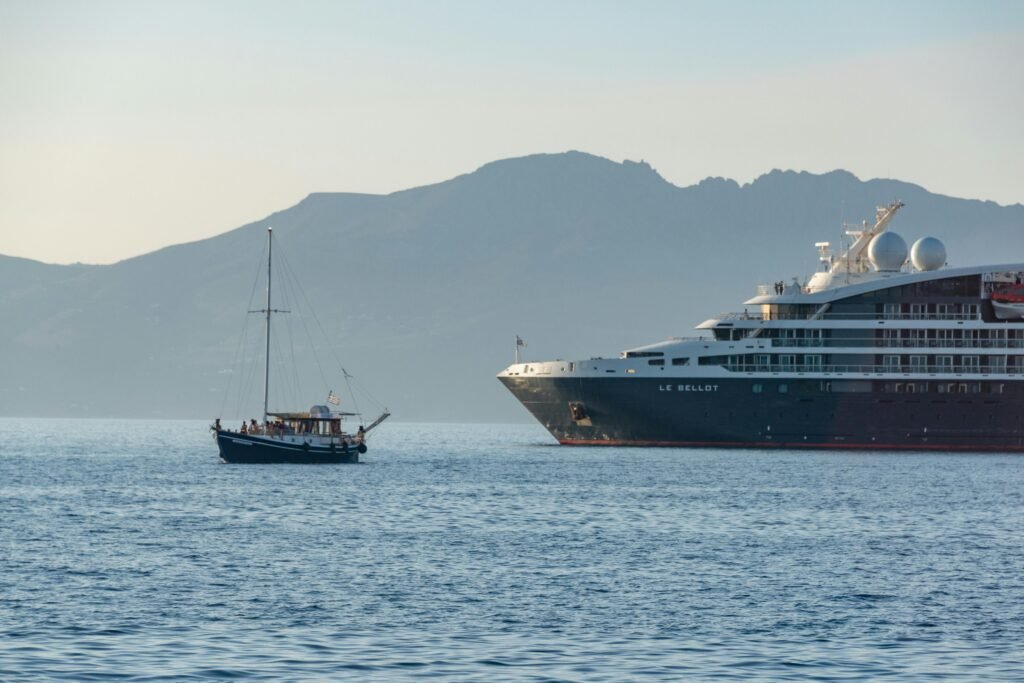
The outbreak of Hantavirus aboard the expedition cruise ship MV Hondius has been rather startling. Hantavirus is a rodent-borne virus that typically is not associated with cruise ships, including those that go on adventures to the Antarctic.
Transmission to humans is usually from exposure to aerosolized particles of rodent feces or fluids. Hantavirus has a long incubation period and a fairly high case fatality rate, so it’s no wonder this outbreak is concerning.
News of the outbreak broke on Sunday, May 3, and was quickly picked up by the media. Since then it’s been a whirlwind. So as of today, what exactly do we know about the Hantavirus outbreak on the cruise ship, MV Hondius?

Timeline: How many Hantavirus cases have there been on this cruise ship?
As of May 6, 2026, there are currently 8 cases of Hantavirus (although not all have been officially confirmed by testing). The timeline of these cases in context with locations visited by the ship is as follows:
On April 1, the cruise ship departed from Ushuaia, Argentina.
On April 5, the cruise ship stopped at the South Georgia Islands.
On April 6, the first case, a man from the Netherlands, developed symptoms of fever, headache, and mild diarrhoea on board the ship. His condition progressed and he developed respiratory distress, and died on board on April 11. The body of this passenger was removed from the cruise ship and taken to St. Helena island on April 24. No tests were performed at that time. (WHO, DON report)
On April 13, the cruise ship stopped at Tristan da Cunha.
On April 22, the cruise ship stopped at St. Helena.
On April 24, the second case, the wife of the first case, departed the cruise ship at St. Helena to accompany her husband’s remains. She had gastrointestinal symptoms at that time. According to the WHO, the woman, “subsequently deteriorated during a flight to Johannesburg, South Africa” on April 25, and she “died upon arrival at the emergency department” on April 26. Hantavirus was confirmed later on May 4.
On April 24, the third case, a man on the cruise ship, reportedly went to the ship’s doctor “with febrile illness, shortness of breath and signs of pneumonia.” His condition continued to worsen and he was evacuated from the cruise ship on April 27, and taken to a hospital in South Africa. Hantavirus was confirmed by PCR testing on May 2. (WHO, DON report)
On April 27, the cruise ship stopped at Ascension Island.
On April 28, the fourth case, a female passenger, experienced symptoms of “fever and a general feeling of being unwell.” She died on May 2. (WHO, DON report)
On May 3, the cruise shipped stopped off the coast of Cape Verde, but was not permitted to dock at port.
On May 4, three additional people on board were considered suspected cases, with reported “high fever and/or gastrointestinal symptoms.” (WHO, DON report) The cruise ship company, Oceanwide, reported that two of those suspected cases were in crew members and had “acute respiratory symptoms, one mild and one severe.”
On May 6, WHO reported that those three suspected cases have been evacuated for medical treatment. This group includes a Dutch national, a British national, and a German national, two of which are symptomatic.
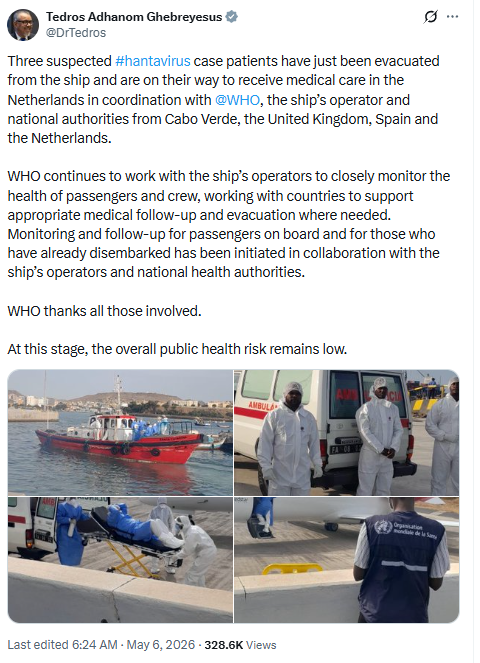
Notably, the ship’s doctor was one of the three people evacuated. His condition has reportedly improved after initially being noted as “in serious condition.”
The fact that the cruise ship’s doctor is infected with Hantavirus speaks to the risk of human to human transmission with the Andes strain. Presumably, the doctor was infected while examining others. Indeed, we know from the earlier WHO report that case 3, the man hospitalized in South Africa, “presented to the ship’s doctor” on April 24. Whether that means case 3 gave it to the doctor is unkown. Hopefully they can map out transmission patterns.
Of the other two people evacuated, the person from Germany is apparently not experiencing symptoms, but “came into contact with an infected person on board” and is will be transferred to a hospital in Germany. This close contact was with the German passenger who died of the virus on May 2 (case 4).
But the case count does not stop there.
Some Passengers left the Cruise Ship and went Home before Hantavirus was Found
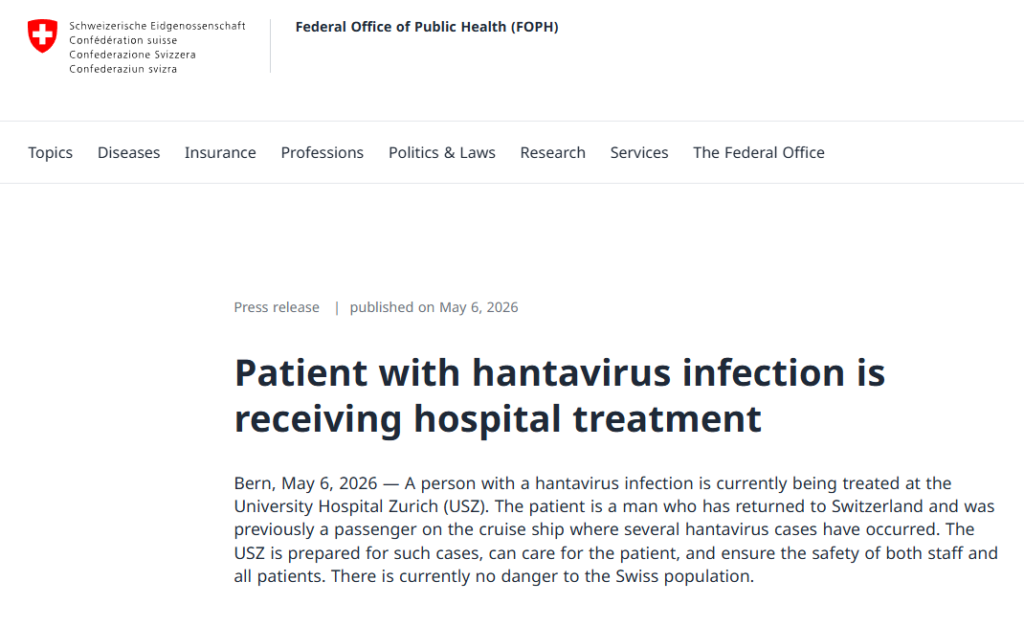
Early on May 6, Swiss health authorities identified a Hantavirus case in a man who had traveled on the same cruise ship, with his wife, but returned home at the end of April. He is currently hospitalized with the Andes strain of Hantavirus.
The details of this new case are not clear. It sounds like this person left the ongoing cruise early, since it departed in early April. Did he leave because he felt sick? We do not know. Although one news report discussing the Swiss case stated: “Simon Ming, spokesperson for the federal office of public health in Switzerland, said in an email to AP that the patient left the ship during its St. Helena stop in late April. It was not immediately clear when or how he returned to Switzerland.”
The cruise ship stopped at St. Helena from April 22 to April 24. It was on April 24 that the body of the first case was transported to the island, accompanied by his wife, the second case. So sometime during those three days, the Swiss patient (case 8) departed the ship with his wife. It is unclear how many interactions that person may have had with anyone else on St. Helena, but the local government has already issued public health notices of the potential exposure to Hantavirus.
According to the cruise ship company, Oceanwide, this passenger “traveled on the first leg of the voyage (Ushuaia to St Helena, 1–24 April 2026).”
Additionally, there are now reports that many more passengers disembarked the cruise ship on St. Helena, just as the Swiss man did. No new cases have been reported yet. Suddenly, contract tracing just took on a new dimension, as the passengers were from different countries.
For example, in the United States, NY Times reported that three states are monitoring people that left the cruise ship before the first Hantavirus case was reported. Health departments in Georgia, California, and Arizona are monitoring residents, although it is unclear how many. The situation is clearly still developing, as MedPage Today reports five states are monitoring residents. As of right now, no one is reported symptomatic. As of May 8, we can add New Jersey to the list of states that are monitoring people who may have been exposed.
The NY Post reported, according to the WHO, those passengers who left the cruise were later informed of the Hantavirus outbreak. They were asked to monitor themselves and to report any symptoms. The cruise ship company is also working on contact tracing efforts, as passengers apparently disembarked “on the various legs of the voyage.”
The Flight to Johannesburg – Hantavirus Exposure by Contact with Cruise Ship Passenger (Case 2)
Finally, there are also news reports that a French national has been “identified as a contact case” of the second Hantavirus case, the Dutch woman who took a flight to Johannesburg.
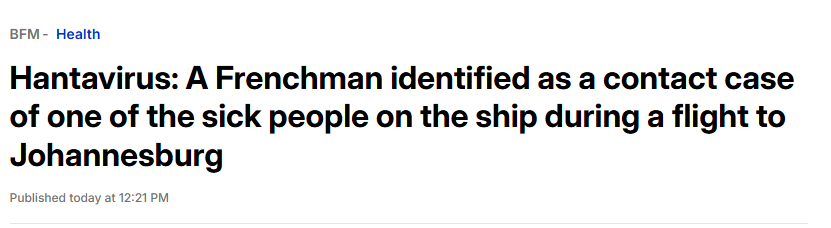
According to reports: “The French contact case is believed to have traveled on the same flight as one of the two patients who were evacuated to Johannesburg for hospitalization at the end of April.”
In total, that makes 8 cases so far, not including the potential “contact case” from the flight, which I would like more information on. This may not even be an actual case of infection with the virus, but a case of a “contact” and thus a potential case.
There were reportedly 82 passengers and 6 crew members on the flight from St. Helena to Johannesburg.
Subsequently, the Dutch woman (case 2) briefly boarded a second flight headed to Amsterdam. She was not permitted to stay on the plane due to her medical condition, as reported by the airline:

As for this second encounter, a flight attendant from the KLM flight was hospitalized after having contact with the Dutch woman before she left the plane. The flight attendant had “mild” symptoms.
As of May 8, the flight attendant tested negative for Hantavirus, so that’s good news. Health authorities are contacting all passengers on board that flight, as well as the first flight to Johannesburg.
However, more suspected cases have popped up.
On May 8, Spanish authorities reported a suspected Hantavirus case in a woman who was a passenger on the flight to Johannesburg. She is currently hospitalized in isolation, with symptoms of cough and general malaise. This woman “was sitting two rows behind the cruise ship passenger” and only had “brief” contact with her. Contact tracing is underway for this Spanish woman’s contacts.
On May 8, the UK reported “an additional suspected case in a British national on Tristan da Cunha.” No further information is known on this suspect case. We do know that the cruise ship stopped at Tristan da Cunha on April 13
What is Hantavirus and how does it spread to people?
Hantaviruses are found in rodents, like certain species of rats or mice. Typically human cases are linked to exposure to those animals’ feces or urine, like when someone cleans out a garage or shed with out rat feces inside it. Those feces can produce particles during sweeping or cleaning and can be inhaled, thus leading to infection with the virus.

The case fatality rate can be up to 50% according to the WHO. There is no vaccine or specific treatment for Hantavirus, with supportive hospital care the primary means of fighting the viral infection.
We still don’t know exactly how people were exposed to the Hantavirus on this cruise ship.
However, we do have a new hypothesis:
According to investigators in Argentina, officials believe the Dutch couple (the first two cases) may have “contracted the virus during a bird-watching outing in the city of Ushuaia before boarding.” The husband and wife reportedly “visited a landfill during the bird-watching tour” and there may have “been exposed to rodents carrying the infection.” Reporting to the Associated Press, “[t]he officials spoke on condition of anonymity.” So take this hypothesis with caution at this stage, as it seems plausible but there’s nothing definitive.
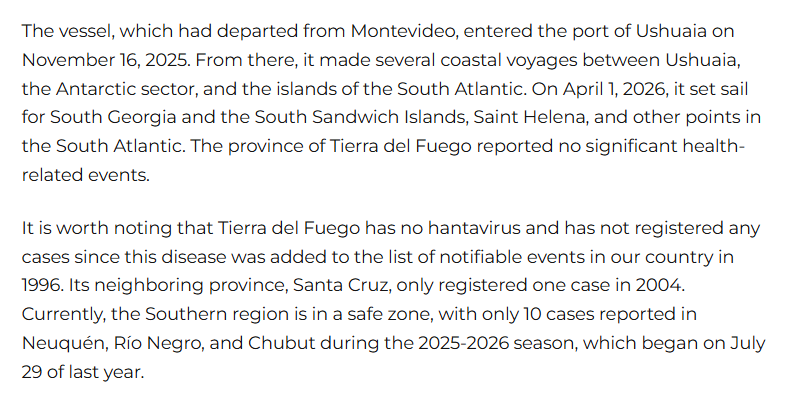
Moreover, Argentina’s Ministry of Health previously stated that this cruise ship had been operating out of a region that had no Hantavirus activity reported:
And what about the other cases on board? How did the other infected passengers get Hantavirus on a cruise ship? Were they exposed to the same source prior to departing or were they exposed later on board?
There is one strain of Hantavirus that is known to transmit between people, although not to the level as covid or flu. The Andes strain of Hantavirus, found in South America, has been documented to transmit between humans in prior outbreaks. Although such transmission is still considered rare, it can happen.
One study published in 2020 examined an outbreak in Argentina during 2018-2019 where 34 people were infected and 11 died. The outbreak was driven by three people at several social events.

This study has gotten a lot of media attention over the past few days given its link to person to person spread of Hantavirus. But what I found most troubling was this statement: “The outbreak involved up to four generations of infections in humans and resulted in more cases than previous person-to-person outbreaks of ANDV. . . On the basis of both the epidemiologic and genomic investigations of person-to-person transmission events, it appears that inhalation of droplets or aerosolized virions may have been the routes of infection.”
Not only did this strain of the Andes Hantavirus spread between humans, but there was onward transmission of the virus, so at least a limited amount of sustained transmission. Indeed, this “super spreading capability” defined this 2018 outbreak, with the virus being capable of “continuous chains of transmission if no control measures are enforced.”
Moreover, the study notes the possibility of airborne spread between people, rather than just droplet spread. That would make spreading the virus much easier, if a person is infectious.
So what are we seeing on the cruise ship?
In this Hantavirus outbreak, health authorities were operating under the assumption that they were dealing with the Andes strain, given the suspected human transmission. That suspicion was confirmed early on Wednesday, May 6. As WHO reported, the Hantavirus in this outbreak is of the Andes strain. Although not surprising, it is certainly concerning given the potential for human to human transmission.
Indeed, WHO issued an update on May 4, in which healthcare facilitates were advised to implement “droplet precautions during close contact” with patients.
But that’s only a part of the overall issue. How exactly did the virus transmit and between whom remain important unkowns at this stage. The mechanisms of transmission are incredibly important aspects to understand here as it would define who is at the most risk of becoming ill.
Where is the cruise ship now and what are the passengers doing?
The cruise ship is proceeding towards the Canary Islands. The ship is expected to get there on May 10. Previously, it was anchored off the coast of Cape Verde.
We now have reports that the ship is expected to dock at Granadilla on Tenerife in the Canary Islands early on Sunday, May 10.

The passengers have remained in their cabins since the first cases of Hantavirus were confirmed. A quarantine at sea.
Given the action an exploratory nature of the cruise itself, I can’t even imagine how tough that would be, with the added fear of an infectious virus on board. The cruise ship company Oceanwide reported that two infectious disease physicians will be boarding the ship, which remains off the coast of Cape Verde.
Some passengers have been active on social media, like this travel vlogger who posted on May 6 that all other passengers on board are receiving support and none are currently exhibiting symptoms.
From all recent reports, it appears that the cruise ship will be heading to the Canary Islands. After the ship was denied entry by Cape Verde authorities, it was up in the air where the ship would be allowed to dock. It will be interesting to see the measures taken once the ship does find a port. Infection control is a real concern, especially since we know that the strain of Hantavirus in this outbreak is the only one known to transmit between people.
But what happens when the ship docks?
We now have an update on the disembarkation protocol once the ship gets to the Canary Islands. There will be a quarantine of all the passengers that have been on the ship since April 1 (so excluding the health workers recently deployed to the ship).

From this health update it’s unclear if that means all passengers or only Spanish citizens. Most likely the latter, as other reports state that citizens will be repatriated to their home countries. I doubt if Spain would want to be responsible for a quarantine of all passengers on board.
Indeed, as to the American passengers, the CDC is going to transport them to a quarantine center in Nebraska where they will be monitored. There are 17 Americans on board the cruise ship. UNMC has specialized quarantine units for infectious pathogens, so it looks like the passengers will remain isolated a bit longer.
As we wait for the ship to arrive in the Canary Islands, we also await any further cases or suspected cases as contacts are traced. As long as anyone with potential exposure listens to health authorities, monitors for symptoms, and agrees to self-quarantine until they know they are not sick, this should be contained.
What about the risk of Hantavirus exposure from passengers to remote wildlife?
One question that I haven’t seen explored is the potential exposure of the virus to other wildlife from the cruise itself.
The MV Hondius is an Antarctic exploration cruise, and the route takes people to remote places like St. George’s island. Passengers seem to get fairly close to penguins and other wildlife. I wonder if these populations have ever been exposed to Hantavirus and if not, is there a risk now? At the time that this ship went to St. George’s Island, some passengers may have been unknowingly sick. If they went to shore and explored the local area, which is the point of these exploration cruises, what’s the risk?
Let us not forget that these islands near the Antarctic coast recently had outbreaks of avian flu in many of the animal populations, including sea lions and penguins. These animals are vulnerable just like people are to new diseases.
In a weirdly ironic twist, I came across the following social media post from a travel vlogger who is a passenger on the exploration cruise ship at the center of this Hantavirus outbreak. His posts provide a nice timeline of travels and give some details about what people generally did on this ship each day. (This was before the outbreak). There were a lot of group lectures and meetings/discussion groups on ship days, lots of time where people are sitting together in a room, and even an ice cream social.
One post I found a bit haunting, as it references the risk of bringing something onto the remote islands that could harm local wildlife and efforts to mitigate that risk:
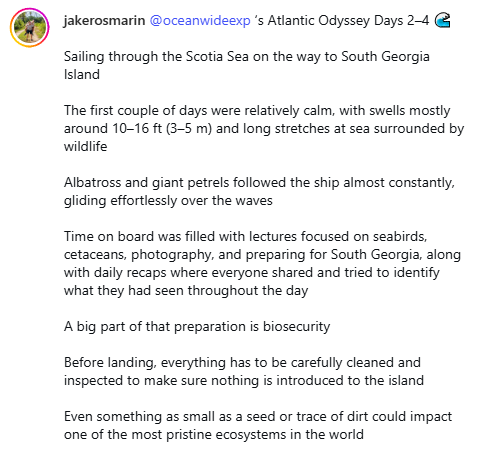
I understand this concern pales in comparison to the risk to human life, but it’s something to keep in mind. It’s comforting that the people on the ship and the company running the whole adventure took steps to address this risk. Let’s hope nothing comes of passengers with Hantavirus potentially interacting with wildlife.
My prayers are with all on board and all the families and friends of those unfortunate passengers who have been stricken or died of the virus. I hope there are no further deaths and that everyone can return safely home as soon as possible.
Until next time,
Flu Huntress.